INFORMATION:
- The product (substance) isn't a food or diet supplement and is not suitable for human consumption.
- Keep out of children's reach
- Keep container tightly closed.
- Store in a dry, cool and shaded place; protect from moisture.
- Store only in the original container.
- Avoid contact during pregnancy and breast feeding.
- Consult a doctor in the event of feeling unwell or having adverse effects related to the contact with the substance.
TP508 – Biochemical Profile and Research Context
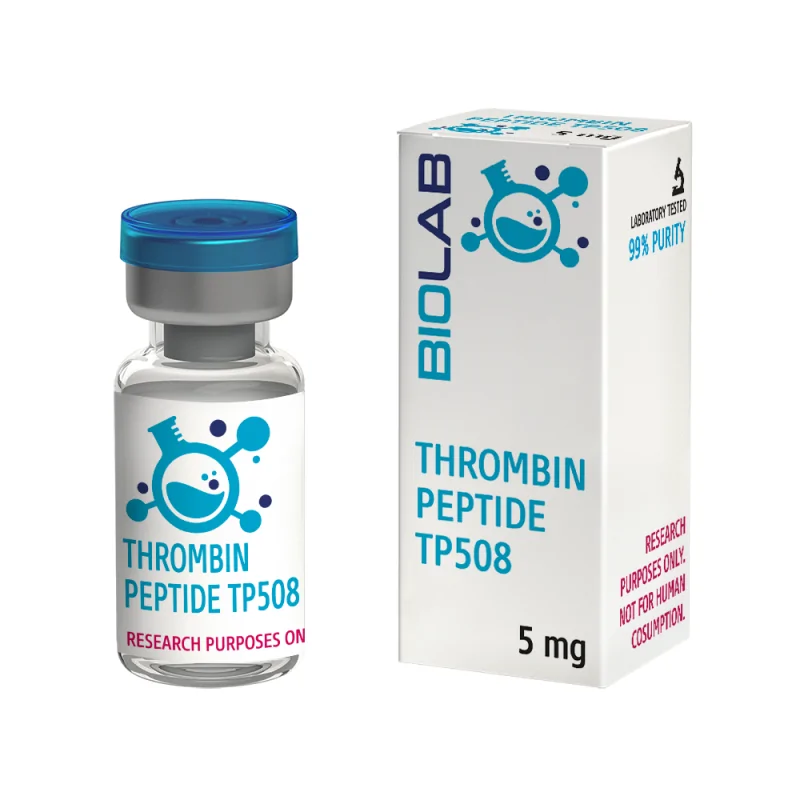
Important notice (research-only): This product is a laboratory reagent intended solely for research use. No dosing, routes of administration, or instructions for human use are provided. The text below is limited to biochemical context and research literature summaries. It is not a food, dietary supplement, or medicinal product.
Molecular Origin and Biological Rationale
In the scientific literature, TP508 is described as a proteolytically inactive thrombin-derived peptide investigated for its cellular-level effects in controlled experimental settings. Research models aim to characterize wound-healing biology at a mechanistic level, focusing on several key biological axes:
- Cytokine Activity: Evaluation of inflammation-related cytokine readouts.
- Enzymatic Modulation: Monitoring of metalloproteinase (MMP) activity.
- Structural Repair: Assessment of angiogenesis- and epithelialization-related endpoints in various model systems.
Bone Healing and Fracture Research
Separate research reports discuss TP508 in the context of bone-healing biology and fracture-related experimental investigations. In these study-specific protocols, the emphasis is placed on objective laboratory and imaging endpoints:
- Radiographic Bridging: Quantitative readouts of bone continuity in injury models.
- Temporal Markers: Time-to-healing markers as assessed in preclinical and clinical-research cohorts.
- Cohort Stratification: Study designs often include subgroup analyses for populations identified as having a potential for delayed healing processes.














Your review appreciation cannot be sent
Report comment
Report sent
Your report cannot be sent
Write your review
Review sent
Your review cannot be sent
Customers who bought this product also bought:
Lactoferrin 250 mg, 60...
Bifido Guard Harmony, 30...
NAC n-acetyl cysteine 50 mg
GonadoMax 5000iu
Prostamax 20 mg
Matrixyl 20 mg
Bye Acne 425 mg, 60 capsules
MOD GRF 5 mg
Blog
Newsletter
Get a discount on your first order
Expert in supplementation and innovative health, fitness, and beauty solutions.
Category
Our company
E-mail address
info@biolabshop.euWhatsApp
+44 739 8562 456